More highlights from Jama Software®
I’ve worked on a diverse range of projects within Jama Connect®. Here’s a glimpse at some more of my favorites; please reach out if you'd like to explore the stories and process behind them.
Redesigning test step results & status roll-up logic
Problem:
Users were limited to only two test step results, "Passed" and "Failed," despite requests for more options like "Not Applicable" or "Skipped."
Additionally, the test run status roll-up logic was overly complicated and lacked proper documentation for test results.
Solution:
I proposed adding an "N/A" test step result for more flexibility, improving the status roll-up logic, and providing clearer options for users to document and manage different test results.
This included allowing "N/A" to be applied to individual steps or full test runs, ensuring users could more accurately reflect the execution state without disrupting the existing workflow.
Improving Accessibility in Jama Connect’s Color Palette
Problem:
Jama Connect's color palette failed to meet many accessibility standards outlined in WCAG 2.0, particularly the minimum color contrast ratio of 4.5:1 for text and graphical elements.
The current color library lacked consistent luminance across hues, leading to contrast issues and making it difficult to ensure accessible text readability, especially for colorblind users.
Solution:
Following the color-work strategy outlined by James Sullivan, I updated our color palette by ensuring consistent luminance patterns across all color ramps, with specific adjustments to green, teal, and yellow hues to improve contrast.
By adopting the Accessible Perceptual Contrast Algorithm (APCA) for more accurate contrast measurement, we created a smoother, more accessible color system that meets both WCAG and APCA standards for different text types, including spot and content text.
Improving test plan organization
Problem:
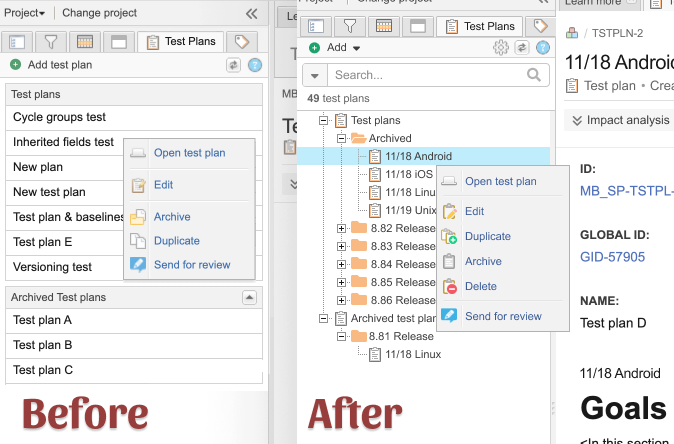
Managing test plans in a flat, alphabetical list made it difficult for users to organize and find plans, especially as projects scaled.
Archived test plans were also separated and poorly integrated, creating further navigation challenges.
Solution:
A new folder-based structure was implemented, allowing users to organize test plans with custom ordering, nested folders, and improved search functionality.
Archived test plans were integrated into this structure, enhancing discoverability and scalability for future enhancements like test groups and cycles.